What actually happens in the K-pop Robot Arena — songs, choreography, and a story
The opening-day show was built from familiar K-pop tracks, taekwondo movement and a single narrative thread. Here is that structure, from on-site reporting.
Key takeawayOn Galaxy Robot Park’s opening day, 21 August 2026, the Robot Arena staged robot group routines to YENA’s ‘Catch Catch’, Big Bang’s ‘Bang Bang Bang’ and ROSÉ and Bruno Mars’s ‘APT.’, plus taekwondo spinning kicks and a boxing show. Cheonji Ilbo reported a robot character called Stella within a storyline; Seoul Economic TV showed Stella dancing and performing taekwondo. Target: at least four shows a day, over 1,000 a year.
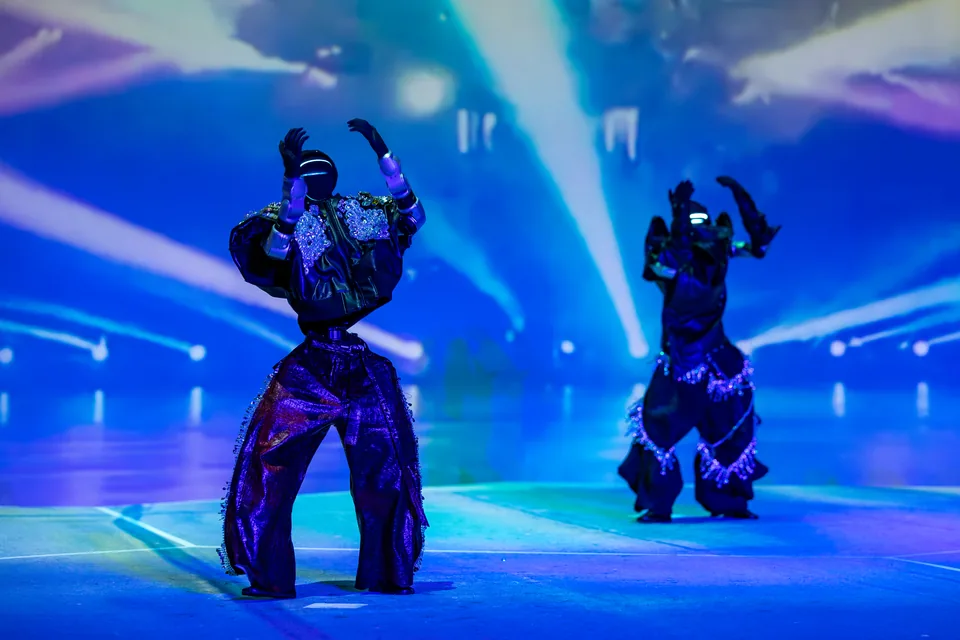
The songs on the setlist
On opening day the Robot Arena staged large-scale robot group routines to tracks including YENA’s ‘Catch Catch’, Big Bang’s ‘Bang Bang Bang’ and ROSÉ and Bruno Mars’s ‘APT.’. That is the opening-day programme as reported by Cheonji Ilbo on 21 August 2026.
According to the same report, the roughly 5,000-pyeong park officially opened that day, cumulative pre-opening attendance stood at 20,000, and every advance-booking session had sold out. It also reported that 17 robot types — portrait robots, ice-cream-making robots, piano-playing robots and hugging robots among them — were added for the official opening.
A boxing show followed the group routines. Quoting Choi Yong-ho, Cheonji Ilbo reported his view that 20,000 visitors before the official opening showed robots could move beyond industry and become entertainment.
Sharing the stage with people
The joint performance between human dancers and robots incorporated taekwondo movement, and the audience was reported to have erupted when the robots delivered spinning kicks.
According to Cheonji Ilbo, taekwondo movement was built into the joint performance of robots and human dancers, and a separate taekwondo spinning-kick demonstration by the robots was also described. The staging places people and robots on the same stage, and the report listed it alongside the K-pop group routines and the boxing show as one of the elements of the opening-day programme.
For reference, Galaxy Robot Park aims to run at least four performances a day and more than 1,000 a year on a permanent basis after its official opening.
The story inside the show
The performance carried a narrative: a robot called Stella, left alone on a ‘planet of loneliness’, watches the other robots perform and recovers her joy and courage. Cheonji Ilbo reported that the robot character Stella appears within this narrative structure.
If the group routines, taekwondo and boxing are each a spectacle in their own right, Stella’s story is the device that ties those scenes into a single flow. According to the same report, the company is developing its own character robots and a robot OS in parallel, and Choi Yong-ho said that ‘after K-pop comes the combination of content and physical AI’.
Built to be repeatable
An OS that lets several robots of different models dance together at the same time is described as the foundation of this show. In its report on the press conference of 21 August, the English edition of Seoul Economic Daily said the robot OS ‘Soulware’ transfers a choreography video into 3D simulation and reinforcement learning, and enables synchronised routines across different robot models through foot-grip control and joint-tremor correction. The company announced plans to commercialise it in 2027.
In a broadcast report on 24 August, Seoul Economic TV introduced ‘Stella’, a robot performing K-pop dance and taekwondo moves, and covered the Robot Arena demonstrations and experiences at the 21 August opening, along with the addition of 17 new robot types. Read together with that on-site report, the staging comes into sharper focus.
Seoul Economic Daily reported that humanoid robots demonstrated choreography to a Big Bang track at the press conference. What was seen on stage and the description of the OS complement each other, but the coverage does not specify which technology drove any particular performance.
Choreography and narrative serve different roles
In group choreography, the timing and formation of many robots create a scene. In the story, the character of Stella gives the audience a way to follow the emotion of that scene. The same movement can take on a different meaning within a show depending on the music, the order of entrances and the relationship to the human performers — and that is the lens through which this content is read here.
The songs named in opening-day coverage are the repertoire recorded that day; they are not assumed to be the fixed set list for every performance now. Nor does a successful stage scene establish the error rate across repeated shows or full autonomy. Keeping the technical explanation of the choreography apart from the account of the staging makes clear what each one shows.
Frequently asked questions
Which songs were performed at Galaxy Robot Park’s opening show?
According to Cheonji Ilbo, the Robot Arena performance on opening day, 21 August 2026, included YENA’s ‘Catch Catch’, Big Bang’s ‘Bang Bang Bang’ and ROSÉ and Bruno Mars’s ‘APT.’. These are the songs recorded that day, not a fixed set list for every performance.
Who is the robot Stella?
Stella is a robot character who appears in the Galaxy Robot Park show. Cheonji Ilbo described a storyline in which Stella, left on a ‘planet of loneliness’, recovers her courage by watching the other robots perform, and Seoul Economic TV reported Stella performing K-pop dance and taekwondo moves.
Do people perform alongside the robots in the Robot Arena?
Yes. The opening-day show on 21 August 2026 was reported to include a joint performance by human dancers and robots that incorporated taekwondo movement. A spinning-kick demonstration by the robots and a boxing show followed.
How often are the robot shows at Galaxy Robot Park?
After its official opening on 21 August 2026, Galaxy Robot Park aims to run at least four performances a day and more than 1,000 a year on a permanent basis. Check the park’s official channels for the schedule and the latest visitor information.