Robots at the park — choreography, mirroring and everyday services
Reported activities include K-pop group choreography, movement-mirroring experiences and portrait, ice-cream and piano robots. These roles involve different interactions and should not be assigned a single level of autonomy.
Key takeawayPress coverage sorts the robots at Galaxy Robot Park into three strands. At the Robot Arena vision ceremony covered by ZDNet Korea on 15 May 2026, humanoid robots performed six K-pop songs and a mirroring system driven by a person’s movements was demonstrated; Asia Today’s 21 August opening report featured portrait, ice-cream and piano robots. Seventeen new robot types joined at the opening — types, not units.
Robots as performers
Yonhap News Agency covered the opening stage shared by robots and human dancers. Group choreography is content that presents not just one robot’s movement but the positions and timing of many bodies as a single scene. What the audience sees is a performance; the training method and control architecture cannot be read from footage alone.
For reference, Galaxy Robot Park officially opened on 21 August 2026 and aims to run at least four performances a day and more than 1,000 a year on a permanent basis after the official opening. These figures are facts confirmed by the company and are recorded here separately from what Yonhap reported.
Movement supplied by a person
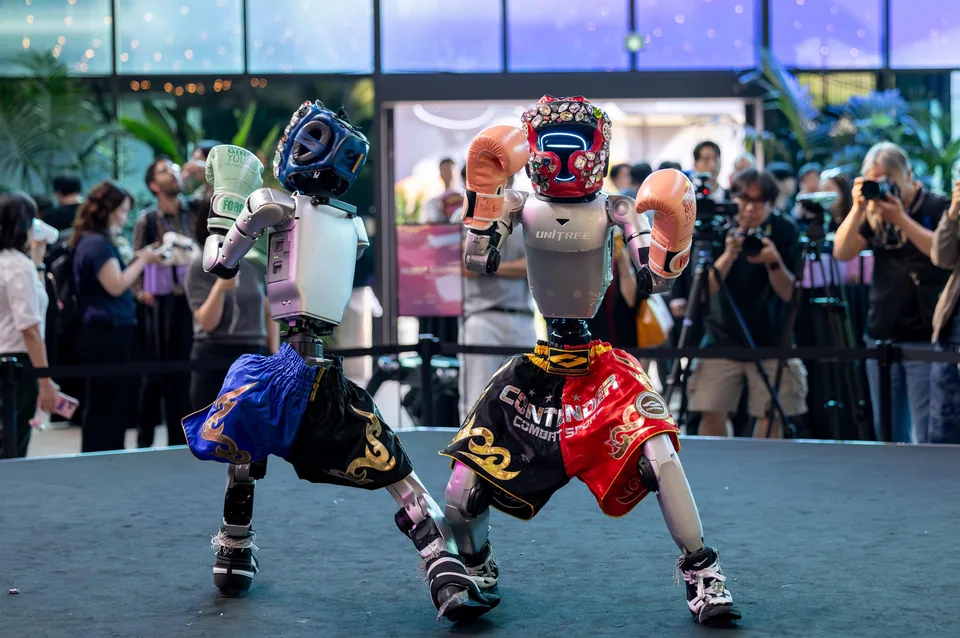
ZDNet Korea’s on-site reporting described a mirroring experience in which a robot is controlled by following a person’s movements. According to the article, the official opening and vision ceremony took place on 15 May 2026 at the Robot Arena of Galaxy Robot Park in Gangdong-gu, Seoul; humanoid robots performed six songs, including tracks by G-Dragon and Taemin, followed by robot boxing, robot portraits and a demonstration of the mirroring system.
In this format the human input is what matters. Describing it as autonomous boxing, in which a robot recognises an opponent on its own and works out tactics, would misrepresent how the experience works. ZDNet Korea set out the robots’ capabilities under three headings: choreography learning, synchronised group dancing and human-motion mirroring.
The performance plan reported at the time was to start with three shows a day, expand to a maximum of six and aim for more than 1,000 a year. The post-opening target was restated as at least four a day, so any performance count needs to be read together with the date of the report.
Different service outcomes
Asia Today introduced portrait, ice-cream and piano robots. Its photo coverage of the grand opening and press conference in Gangdong-gu, Seoul, on 21 August 2026 showed a robot drawing portraits, a robot making ice cream and a robot playing the piano, and reported that the Robot Arena stages large-scale group performances combining K-pop with robotics.
Because the outcomes — a picture, food, music — differ, so does the way visitors take part. For a portrait the visitor sits as the subject; for ice cream the visitor receives a finished product; for the piano the visitor listens to a performance. Asia Today described these as scenes of physical AI realised in everyday life, and relayed the company’s point that visitors can both watch the robots and try them out for themselves.
A service label on its own does not establish whether generative AI is used or whether every step runs without human assistance. What was reported is the outcome and the scene; how things are processed internally is a matter for separate technical documentation.
What does 17 new types mean?
‘Seventeen new robot types’ is the wording of reports relaying the company’s announcement at the opening. In its report on the day of the grand opening, 21 August 2026, Asia Economy Daily said 17 robot types had been newly added, listed robot boxing, hugging robots, drawing robots, portrait robots, ice-cream-making robots and K-pop choreography robots, and noted a new programme in which visitors operate robots themselves.
The figure is not rewritten as 17 individual units or as the total number of types currently in operation. The same article also reported the 20,000 cumulative pre-opening visitors and the newly opened restaurant, bakery, café and ice-cream shop, all of which are likewise figures from the opening announcement.
The classification in this article exists to compare reported roles; it is not a manufacturer’s specification sheet. The division into performance, hands-on control and everyday service is an editorial arrangement based on the scenes a visitor encounters.
Frequently asked questions
What kinds of robots are there at Galaxy Robot Park?
According to press coverage, Galaxy Robot Park has K-pop choreography robots, robot boxing, hugging robots, drawing robots, portrait robots, ice-cream-making robots, piano-playing robots and a programme in which visitors operate robots themselves. Seventeen new robot types joined at the official opening.
What is the mirroring experience at Galaxy Robot Park?
The mirroring experience is a format in which a robot is controlled by following a person’s movements; ZDNet Korea covered a demonstration at the Robot Arena vision ceremony on 15 May 2026. Unlike autonomous movement, where a robot makes its own decisions, human input is central.
Does ‘17 new robot types’ mean 17 robots?
No. ‘Seventeen new robot types’ is the number of types of robot added for the official opening on 21 August 2026, as announced by the company. It is different from the number of individual units or the total number of robot types currently in operation.
How many times a day are the robot shows at Galaxy Robot Park?
Galaxy Robot Park aims to run at least four performances a day and more than 1,000 a year on a permanent basis after its official opening. Reports in May 2026 described an earlier plan of three shows a day rising to a maximum of six, so the date of each report needs to be checked.